
Healthcare App Design and Development: What Actually Drives Patient Engagement
- annalarionova6
- Mar 19
- 7 min read

Most healthcare apps get abandoned within the first week. Not because patients don't care about their health - but because the app made managing it harder, not easier. Poor healthcare app design isn't just a UX problem. It's a clinical one.
At Softvery Solutions we've built healthcare app design and development projects from the ground up - including a HIPAA-compliant platform for an FDA-cleared medical device manufacturer that handles smartphone-based gait analysis, multi-clinic role management, and real-time treatment monitoring. See the full AposHealth case study for details on how it was built and what it delivered. This article shares what we've learned about what separates healthcare apps patients actually use from ones that collect dust.
Why healthcare app UI/UX is harder than standard product design
A healthcare app design company is not interchangeable with a general product agency. Healthcare apps carry a different weight: regulatory requirements, sensitive data, multiple user types - patients, clinicians, administrators - and design decisions that can directly affect health outcomes.
The core challenges we encounter repeatedly across custom healthcare app design projects:
Fragmented systems - most healthcare apps exist in isolation. Patients switch between separate apps for scheduling, records, and lab results. Every context switch costs engagement and erodes trust in the product.
Data complexity - medical information is dense by nature. When a healthcare SaaS UI UX design agency doesn't design for clarity, both patients and clinicians stop trusting the interface and work around it.
Divergent user types - a patient-facing healthcare app and a clinician tool have almost nothing in common in terms of information hierarchy, interaction speed, and tolerance for error. Building both in one platform, as we did for AposHealth, means designing two distinct interaction models on the same data layer.
HIPAA compliance and usability tension - security requirements are non-negotiable. But poorly implemented compliance creates friction that drives abandonment. The best HIPAA compliant healthcare app design makes the compliance layer invisible to the end user.
What good healthcare app design actually looks like
Research before wireframes
Every bespoke healthcare app design engagement should start with structured user research, not assumptions. For our medical device app design work with AposHealth, this meant understanding the workflow of clinicians managing multiple patients across clinic locations, alongside the far simpler but emotionally loaded experience of an osteoarthritis patient checking treatment progress at home. Two completely different design problems, one platform.
Surveys and interviews surface the obvious gaps. Usability testing surfaces the ones that will kill adoption - the 70-year-old patient who can't tap a button that's two sizes too small, or the clinician who needs a critical data point in two taps, not seven.
Navigation that removes friction, not features
Intuitive patient-facing healthcare app design is not minimal design - it's the right things in the right places. A telemedicine app design should let a patient book a consultation in two to three taps. A clinician dashboard should surface the most urgent patient flags without requiring the user to look for them.
Information hierarchy, consistent primary action placement, and reduced cognitive load are the foundations. The practical test: can a new user complete their core task in under 60 seconds without reading an onboarding guide?
Accessibility is not optional in healthcare
Healthcare users skew older and often have physical or cognitive limitations that consumer app designers rarely account for. Healthcare app designers who treat accessibility as a finishing pass are designing for a user who doesn't represent the majority of people who actually use these products. Voice navigation, screen reader compatibility, high-contrast display modes, and large touch targets are baseline requirements, not premium features.
Design psychology for sensitive contexts
Patients using a custom healthcare app are often anxious, in pain, or managing a long-term condition. Visual design choices - colour, typography, microcopy - carry more emotional weight than in an ecommerce or fintech app. If you want to see how design psychology applies differently across verticals, our piece on ecommerce PWA development covers the contrast well. In healthcare, calm and clear interfaces reduce anxiety. Transparent data handling copy builds trust. Explicit permission flows prevent the moment a user decides the app doesn't feel safe and uninstalls it.
Advanced capabilities that separate good from great

Connected device and IoT integration
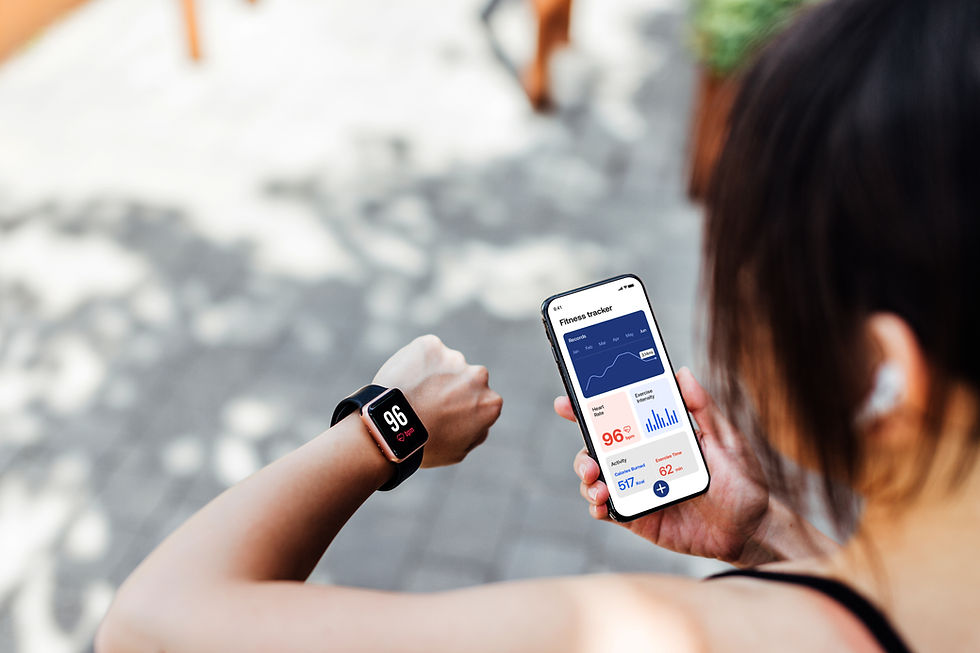
The best custom healthcare app design for medical devices eliminates manual data entry entirely. When a glucose monitor, smartwatch, or gait analysis sensor feeds data automatically into the app, patients stop being data entry clerks and start being data recipients. This is where real engagement happens - when the app does the work and shows the patient something they couldn't see before.
For pharma and healthcare app designers working in chronic disease management, IoT integration isn't a feature - it's the core product proposition. Designing for it from the start changes the entire architecture, not just the UI.
AI-powered clinical support
AI assistants in software development healthcare app design have moved well beyond basic chatbots. Natural language symptom triage, intelligent appointment routing, and AI-driven treatment progress summaries are buildable within realistic timelines. The critical requirement: the AI layer must feel trustworthy, not experimental. A user who loses confidence in an AI recommendation stops using that feature entirely - and often stops using the app.
We've applied similar AI-first thinking in other verticals too. Our AI app builder case study shows how we delivered an AI-powered platform from idea to working product in 8 weeks - the same methodology applies when scoping AI features for healthcare.
Scalable architecture for regulated environments
A healthcare app design agency that delivers design without thinking about the engineering underneath it is creating future problems. HIPAA compliant healthcare app design requires end-to-end encryption, audit logging, role-based access control, and compliant cloud infrastructure - all of which need to be designed into the architecture from day one, not added after launch.
When we built the AposHealth platform, dedicated DevOps and backend engineers worked in parallel with frontend and UX from the start - because compliance in a medical device app design context is an engineering problem as much as a design one. The same approach applies when we build insurance SaaS platforms with complex calculation engines and role-based access for hundreds of users.

Get custom healthcare app design from experts
Building a patient-facing or clinician-facing healthcare app and need a development partner with proven HIPAA experience?
We've built healthcare platforms for FDA-cleared medical device manufacturers and helped founders scope compliant products from scratch. Schedule a discovery call or see how we built the AposHealth platform to understand our approach.
Frequently asked questions
What does a healthcare app design company do differently from a general agency?
A specialist healthcare app design company brings domain knowledge a generalist agency doesn't have: HIPAA and GDPR compliance experience, familiarity with clinical workflows, understanding of medical data standards like HL7 and FHIR, and a track record designing for both patient and clinician user types. Design decisions that work in consumer apps - aggressive onboarding, dense information layouts, dark patterns - actively harm adoption in healthcare contexts.
How much does custom healthcare app design and development cost?
A realistic budget for a custom healthcare app design and development project - covering UX research, UI design, frontend, backend, and compliance infrastructure - typically starts around €80,000-€120,000 for an MVP with a nearshore European team. Platforms with IoT integration, AI features, or multi-clinic role management run higher. The best way to get an accurate scope is a discovery sprint before committing to full development - it surfaces the compliance requirements and architecture decisions that most affect budget.
What does HIPAA compliance mean for app design specifically?
HIPAA compliant healthcare app design affects far more than the backend. It shapes UX decisions: session timeout flows, how error messages are written, what data appears in push notifications, how permission requests are structured, and how audit trails are presented to admin users. A design team without regulated environment experience will often propose flows that are technically non-compliant - not out of negligence, but because the constraints aren't visible until you've built inside them before.
How long does healthcare app design and development take?
A focused MVP for a patient-facing healthcare app - covering core user flows, HIPAA-compliant infrastructure, and basic device integration - typically takes 12 to 20 weeks with a dedicated healthcare app development team. The biggest time variable is almost always the discovery and architecture phase. Skipping it to move faster reliably creates more time lost later. For comparison, our ecommerce PWA builds run on a similar discovery-first model and ship in 8 to 12 weeks for a well-scoped product.
Can you outsource healthcare app design and development to a European team?
Yes - and for European founders and medical device companies, outsourcing healthcare app design and development to a nearshore European team has real structural advantages over working with offshore teams in different time zones and legal jurisdictions. GDPR compliance, EU data residency, and timezone overlap for daily collaboration all become significantly simpler. Our team serves clients across UK, Germany, Ireland, and the Nordics. See how we work in our dedicated team model overview.
What is the difference between patient-facing and clinician-facing app design?
A patient-facing healthcare app design prioritises simplicity, emotional clarity, and low cognitive load - patients are often stressed or elderly and completing health tasks as part of daily life. A clinician app UI UX design is built for speed and information density - clinical staff need rapid access to multiple data points, efficient multi-patient switching, and zero ambiguity in critical alerts. Building both in one platform requires two distinct interaction models on a shared data layer. Our AposHealth case study is a detailed example of exactly this challenge.
Do you work with pharma companies and medical device manufacturers?
Yes. Our healthcare app design and development work includes an FDA-cleared medical device manufacturer, and we've delivered platforms that interface with regulated hardware and require formal compliance documentation. Pharma app design and development projects typically require closer collaboration with the client's regulatory and clinical teams - which we treat as part of our standard discovery process rather than an exception to it.



Comments